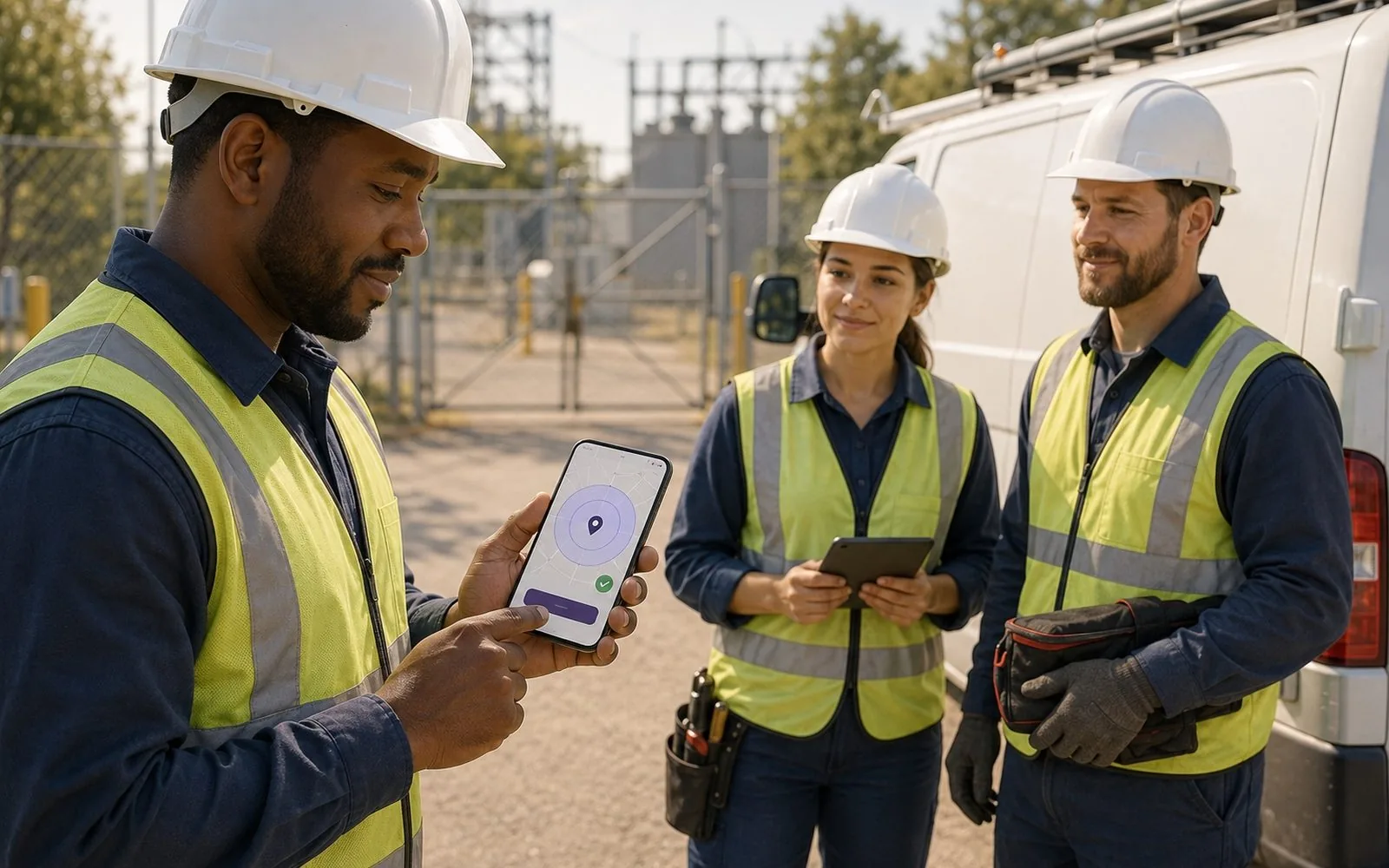

Most internal communication tools are built around an assumption that quietly excludes a large part of the workforce: that employees start their day at a desk, checking email or a company intranet. Field and frontline employees don't work that way, and every announcement built for the desk-first assumption arrives to them late, incomplete, or not at all.
Where the gap actually comes from
It's not that field employees are harder to reach technically — most carry a smartphone and have some connectivity for most of the day. The gap comes from where the communication is placed. Email requires opening an inbox that field employees rarely check during work hours. An intranet requires logging into a portal that isn't part of their daily workflow. A physical noticeboard requires being at a specific location to see it. Each of these channels works fine for office staff because it sits inside a routine they're already in. None of them sit inside a field employee's actual routine.
The pattern that actually reaches field teams
Communication that reaches deskless employees reliably shares one trait: it lives inside a tool they're already opening multiple times a day for another reason. For most field and frontline roles, that tool is whatever they use to check in for their shift, view their tasks, or check their schedule — not a separate communication app they'd need to remember to open.
- Attach announcements to the attendance or task flow — a message that surfaces at check-in reaches people who would never open a separate app for it.
- Keep it short and skimmable. A field employee reading a message between tasks, often outdoors, on a phone screen, isn't going to read a paragraph the way someone at a desk would.
- Confirm receipt for anything that matters. "Sent" is not the same as "seen," and for policy changes or safety notices, knowing who has actually opened the message is often more important than the message itself.
Two-way, not just broadcast
Communication gaps aren't only about announcements failing to reach field staff — they're also about field staff having no equivalent way to reach back. A frontline employee who notices a genuine problem — a recurring safety issue, a client complaint pattern, a process that doesn't work in practice the way it was designed on paper — often has no channel that reaches the right person quickly, and the information either gets lost or arrives weeks late through an informal chain.
A direct chat channel to HR or a supervisor, alongside the announcement flow, closes this loop. It doesn't need to be sophisticated — a simple, always-available message thread beats a formal feedback form that requires deliberate effort to open.
The measure of an internal communication tool for deskless teams isn't how polished the announcements look — it's whether a manager can tell, within a day, how many people actually saw a given message.
What to avoid
Consumer messaging apps used informally for company communication (a WhatsApp group, for instance) solve the reach problem but create new ones: no access control when someone leaves the company, no separation between personal and work communication, and no reliable record for anything that later needs to be referenced — a policy announcement, a safety notice, a shift change. They're a workaround, not a solution, and they tend to persist specifically because the sanctioned alternative doesn't reach people as reliably.
See chat and announcements built for field teams
LaaynHR puts direct messaging, HR announcements, and read confirmation inside the same app employees already use to check in.
A simple test for any communication channel
Before rolling out a new announcement channel, ask a narrower version of the reach question: would this reach an employee who has no reason to check email today? If the honest answer is no, the channel is solving for office staff by default, and field and frontline employees will keep finding out about company news secondhand, later, and less accurately than everyone else.
Turn communication into an operating workflow
For a field organisation, the useful question is not which channel can send a message; it is whether supervisors can see who needs an instruction, where it is acknowledged and what work follows. Start by defining separate paths for urgent operational updates, routine announcements and job-specific discussions.
A practical rollout checklist
- Give site supervisors one documented route for operational updates.
- Keep attendance, tasks and team communication connected to the same workforce process.
- Review adoption by location before adding more channels.
Related solutions: internal communication for workforce teams and field-force attendance and task management.